
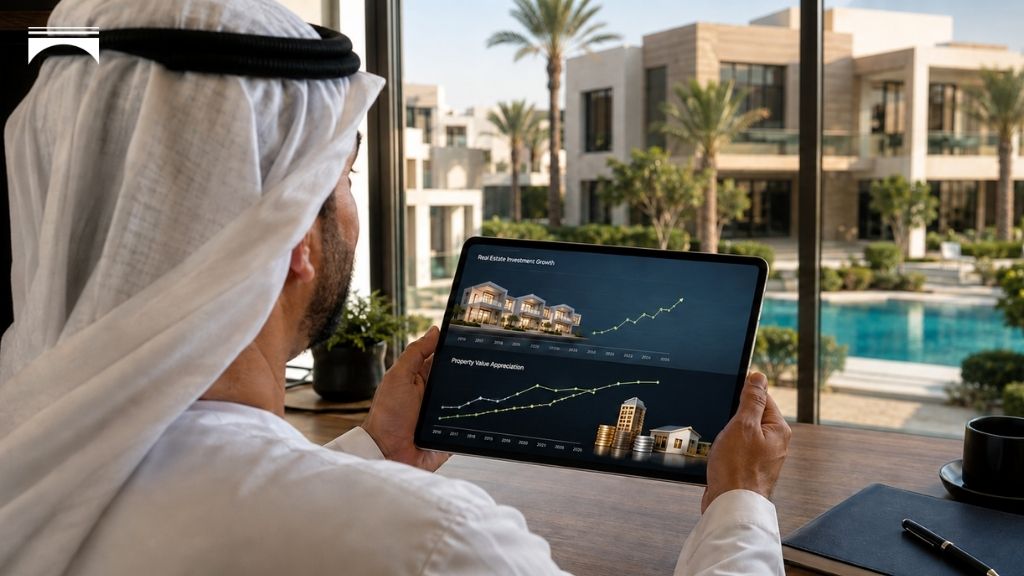
In August 2026, UAE fixed mortgage rates start from around 3.75% and typically sit between 3.95% and 4.75% for terms of one to five years. Variable rates are priced as three month EIBOR, currently 3.88%, plus a bank margin of roughly 1.00% to 2.25%. Fixed suits buyers who want certainty. Variable suits buyers who can absorb movement.
Choosing between the two is the single biggest financial decision most buyers make after choosing the property itself. Here is how the UAE market works in 2026 and how to decide.
The UAE dirham is pegged to the US dollar, so the Central Bank of the UAE moves its base rate broadly in step with the US Federal Reserve. That base rate has been held at 3.65% since the June 2026 meeting.
The base rate feeds into EIBOR, the Emirates Interbank Offered Rate, which is the benchmark UAE banks use when lending to each other. The Central Bank publishes it every business day. As of the 21 August 2026 fixing, three month EIBOR stood at 3.88%.
EIBOR is the number that matters to borrowers, because nearly every variable home loan in the country is written as EIBOR plus a margin. When EIBOR moves, your instalment moves with it.
A fixed rate mortgage locks your interest rate for a set introductory period, usually one, two, three or five years. Your monthly payment stays the same during that window no matter what happens to EIBOR.
The appeal is predictability. You know exactly what leaves your account each month, which makes budgeting straightforward and rental yield modelling far more accurate. The trade off is that you gain nothing if rates fall during the fixed term, and longer fixed periods carry higher headline rates. Exiting early triggers a settlement fee, capped by Central Bank rules at 1% of the outstanding balance or AED 10,000, whichever is lower.
Who Fixed Rates Suit Best:
Fixed works well for end users buying a home to live in, first time buyers without a large cash reserve, families relocating to the UAE, and anyone financing close to their affordability ceiling where a rate rise would genuinely hurt.
A variable rate is built from two parts: a bank margin that stays fixed for the life of the loan, and an EIBOR component that resets at agreed intervals, usually every three months.
At today's fixing, a margin of 1.00% produces a rate near 4.88%, while a margin of 2.25% produces closer to 6.13%. The advantage is that you capture the full benefit immediately if EIBOR falls, and the sharpest margins can beat fixed pricing across a full cycle. The risk is that payments can rise at each reset with little warning, and some lenders apply a floor rate that limits how much of a falling EIBOR you actually enjoy.
Who Variable Rates Suit Best:
Variable works for investors with liquidity to absorb a rise of one to two percentage points, buyers who expect to sell or refinance within two to three years, and anyone who has secured an unusually low margin under about 1.25%.
Here is the detail that costs UAE buyers the most money. A fixed rate in this market is never fixed for the full 25 years. It is fixed for one to five years, then reverts to a variable rate calculated as a margin over EIBOR.
That reversion margin is agreed at the start and buried in the offer letter, yet it governs what you pay for the remaining twenty years or more. A 3.95% three year fixed with a 2.25% reversion margin would revert to roughly 6.13% at today's EIBOR. A slightly higher 4.19% fixed with a 1.25% reversion margin would revert to around 5.13%, and costs far less over the life of the loan.
Ask every lender for two numbers, not one: the fixed rate and the reversion margin.
On a AED 2 million loan over 25 years, a rate of 3.99% produces a monthly payment of approximately AED 10,546. The same loan at 5.88%, which is a variable priced at EIBOR plus a 2% margin, costs roughly AED 12,740 a month.
That gap of about AED 2,194 a month adds up to roughly AED 26,300 a year, enough to swing a rental investment from positive to negative cash flow in its early years. It is also worth stress testing the upside risk: a one percentage point rise in EIBOR adds close to AED 1,200 a month on the same loan.
Central Bank rules cap how much any lender can advance. Expat residents can borrow up to 80% of the value of a first owner occupied property under AED 5 million, meaning a 20?sh deposit. UAE nationals qualify for up to 85%. Second and investment properties are capped lower, non-residents generally sit between 50% and 65%, and off plan purchases are capped at 50% for everyone.
Two further limits apply simultaneously. Total monthly debt repayments cannot exceed 50% of gross monthly income, and most lenders cap the loan at around seven times annual income for expats. Maximum tenure is 25 years.
Budget for the full cash requirement, not just the deposit. The 4% Dubai Land Department transfer fee, 0.25% mortgage registration, bank arrangement fees, valuation and insurance typically add another 6% to 7% of the purchase price, and none of it can be financed.
Off plan financing is capped at 50% and usually draws down at handover rather than at booking. You fund the construction linked instalments from cash, then arrange a mortgage for the completion payment when the property is ready.
The practical result is that buyers purchasing a unit completing in 2027 or 2028 are not locking a rate today. They are securing today's price and financing at whatever rates exist on handover. That separates the purchase decision from the current rate cycle, which is a large part of why off plan demand has stayed strong through a higher rate period.
Understanding your finance options is the first step. Choosing the right address is what builds long term value.
Flora Shore by Calgary Properties is a boutique collection of 76 fully furnished residences on Dubai Islands, a 14 storey beachside landmark with handover scheduled for Q1 2028. Homes span 2, 3 and 4 bedroom layouts, including premium two bedroom residences with private pools, framed by floor to ceiling glass and open Arabian Gulf views. You are two minutes from the Island A yacht marina, five from Dubai Islands Mall and eighteen from Dubai International Airport.
The payment structure works in your favour as a buyer thinking about finance: 20% plus 4% DLD on booking, six staged payments of 5% through construction, and 50% on completion. You build your position while the tower rises, then arrange financing for the completion payment closer to handover.
Register your interest in Flora Shore to receive floor plans, current availability and full payment plan details from the Calgary Properties team, or explore the project and speak to an advisor.
 Share
Share
 Tweet
Tweet
 Email
Email
 Share
Share
 Share
Share

A New Chapter Begins For Flora Shore: Calgary Properties And Flora Realty Join Hands For Waterfront Living
View More
Property Valuation In Dubai: A Complete Guide For Buyers And Investors In 2026
View More
Dubai Rental Market 2026: Why Tenants Are Moving To New Homes For Better Value
View More
Dubai Luxury Rents Reach A AED 1.35 Million Median: What It Means For Waterfront Home Buyers In 2026
View More
Building Trusted Real Estate Developments In Dubai: The Calgary Properties Approach
View More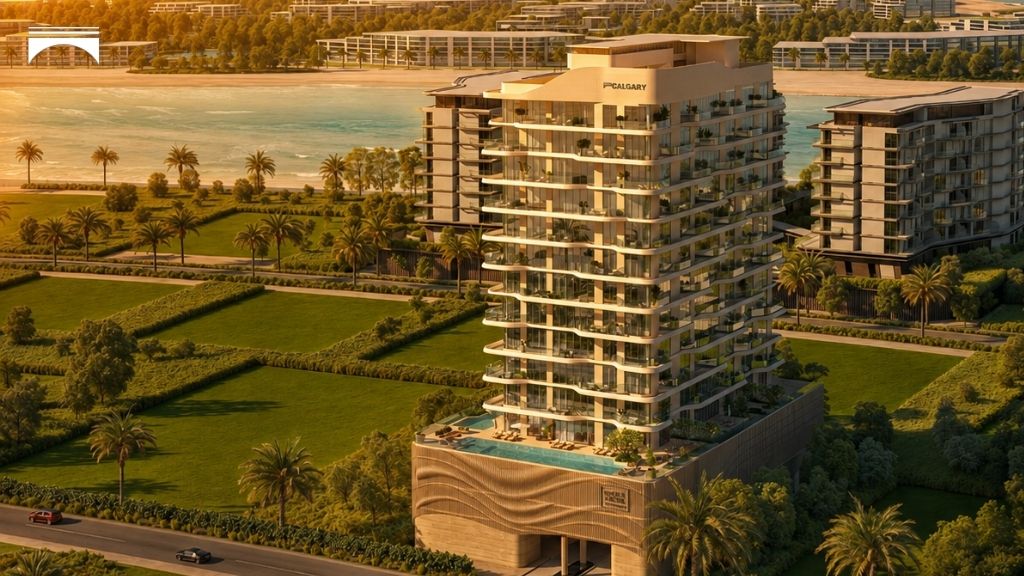
Dubai Waterfront Property Investment: Why Dubai Islands Is Emerging As A High-Growth Destination In 2026
View More
Urban Planning In The UAE: Why The Next Wave Of Cities Is Designed Around People, Not Plots
View More
Dubai Real Estate Buyer Markets In 2026: Why UAE, Saudi Arabia, India And The UK Remain Key
View More
Why Investors Lose Money In Dubai Real Estate, And How To Avoid It
View More
The Psychology Of Flora Shore: How Interior Design Shapes The Way You Live
View More